Most people try to change themselves from the wrong starting point. They focus on the behaviour they want to stop, the habit they want to break, the relationship pattern they want to move away from, or the confidence they want to build, but they rarely stop long enough to ask where these patterns actually came from. That is why so many people can understand their problems on the surface and still keep repeating them. They know they overthink, they know they react, they know they avoid difficult things, they know they self-sabotage, they know the voice inside their head can turn against them, but knowing that something is happening is not the same as understanding why it keeps happening.
That difference matters.
At E.P.I.C. Psychology, the work is not built around giving people a few coping strategies and sending them away to try harder. Most people have already tried harder. They have tried being more disciplined, more positive, more motivated, more patient, more confident, and more controlled. The problem is not always effort. The problem is that they are trying to create change on top of an internal system they do not properly understand.
Your mind did not become what it is by accident. Your reactions, your self-talk, your confidence, your fears, your attachment patterns, your avoidance, your anger, your people-pleasing, your need for control, your mistrust, your self-doubt, and your emotional responses have all been shaped by experience. Some of those experiences were obvious and painful. Some may have been subtle, repeated, and easy to dismiss. Some happened so early that you cannot consciously remember them, but your body and mind still learned from them.
This is where the work has to begin.
Not with shame. Not with blame. Not with pretending the past does not matter. It begins with understanding how your previous experiences shaped the person you became, then taking responsibility for the person you are now choosing to build.
The Person You Are Today Was Built Over Time
A lot of people speak about themselves as if their personality is fixed. They say things like “this is just how I am”, “I have always been like this”, or “my head just works this way”, without realising that many of these so-called personality traits are actually learned adaptations.
If you grew up in an environment where love felt unpredictable, you may have learned to scan constantly for signs that people are going to leave. If you were criticised heavily, you may have developed an internal voice that attacks you before anyone else gets the chance. If you were emotionally ignored, you may have learned to shut down your own needs and convince yourself you are fine. If your life taught you that conflict was dangerous, you may now avoid difficult conversations even when avoidance is damaging your relationships. If your past taught you that achievement was the only way to feel valuable, you may now push yourself relentlessly while still feeling like you are never enough.
These patterns are not random. They are not signs that you are broken. They are evidence that the mind learns from the conditions it has been placed inside.
The issue is that the mind often continues running old protective strategies long after the original environment has changed. A strategy that once helped you survive, cope, gain approval, avoid rejection, stay safe, or feel in control can later become the very thing that holds you back. This is why people can find themselves reacting in ways they do not want to react, thinking in ways they do not want to think, and behaving in ways that are completely out of line with the future they say they want. Until you understand the original function of the pattern, you will usually keep fighting the symptom rather than changing the system underneath it.
Understanding Is Not the Same as Making Excuses
There is an important distinction here.
Understanding what made you this way does not mean excusing every behaviour, avoiding responsibility, or blaming your past for the rest of your life. That is not what we do at E.P.I.C. Psychology. In fact, it is the opposite.
When you understand where a pattern came from, you stop being confused by it. When you stop being confused by it, you can start working with it properly. You can begin to see why the mind produces certain thoughts, why certain people trigger you, why your body reacts before you have had time to think, why you keep returning to familiar situations even when they are damaging, and why part of you may resist the very life you say you want.
That understanding gives you leverage.
Without it, people often end up stuck in a cycle of self-attack. They ask themselves why they are like this, why they cannot just get over it, why they keep ruining things, why they cannot be normal, why they cannot stay consistent, why their mind will not leave them alone. Those questions usually create more shame, and shame rarely produces stable change. It normally drives more avoidance, more defensiveness, more emotional reactivity, and more internal conflict.
The better question is not “what is wrong with me?”
The better question is “what happened, what did I learn from it, how is it still operating now, and what needs to be rebuilt?”
That is a very different starting point.
Building a New Internal Identity
Real change requires more than insight. You can understand your past and still be controlled by it. You can recognise a pattern and still repeat it. You can know exactly why you react badly in a relationship and still react badly when the pressure hits.
This is why identity work is so important.
Your internal identity is the version of yourself that lives beneath the surface. It is not the version you present to other people. It is the version you believe you are when life becomes difficult. It is the part of you that decides whether you feel capable, safe, worthy, strong, disciplined, lovable, respected, or in control.
If your internal identity is built around being not good enough, you will keep interpreting life through that lens. If your internal identity is built around being abandoned, you will look for signs of abandonment even in people who are trying to love you. If your internal identity is built around failure, you will hesitate when opportunity appears. If your internal identity is built around being powerless, you will keep handing responsibility for your emotional state to other people, circumstances, and the voice inside your head.
Changing your life therefore requires rebuilding the way you see yourself from the inside out.
This is not about pretending to be confident. It is not about saying affirmations with no substance behind them. It is about consciously constructing a stronger internal identity through repeated evidence, better thinking, better emotional regulation, better behaviour, and a more disciplined relationship with your own mind.
You do not become a new person by wishing for it. You become a new person by repeatedly acting, thinking, and responding from the identity you are trying to build. That is the work.
The Voice Within Has to Be Trained
One of the most powerful parts of this work is changing your relationship with the voice inside your head.
Most people live as though every thought they have deserves to be believed. A thought appears, and before they have questioned it, they have already reacted to it. The thought says they are not good enough, so they shrink. The thought says something will go wrong, so they avoid. The thought says someone is judging them, so they become defensive. The thought says they have failed before, so there is no point trying again. The thought says they are behind in life, so they compare, panic, and attack themselves.
This is how the mind becomes the master and the person becomes the servant.
The aim is not to stop thinking. That is not realistic. The aim is to stop being dragged around by every thought that appears. You have to learn how to observe the voice within rather than automatically obey it. You have to learn how to separate useful thought from fear-based thought, old protective thought, shame-based thought, distorted thought, and thought that belongs to an older version of you.
This is where metacognition becomes important. Metacognition simply means learning how to think about your thinking. Instead of being trapped inside the thought, you learn to step back and examine it. You start asking whether the thought is accurate, whether it is useful, whether it belongs to the present moment, whether it is helping you move forward, or whether it is just an old internal programme trying to keep you in familiar territory.
When this skill develops, the voice within can stop being an enemy and start becoming an asset.
A trained internal voice can help you stay calm under pressure. It can help you challenge fear before fear controls your behaviour. It can help you interrupt self-sabotage before it takes over. It can help you respond with dignity when old emotions are pulling you towards a destructive reaction. It can help you keep moving when the older version of you wants to quit, hide, attack, or shut down.
This is not soft work. It is mental discipline.
The person who cannot manage their internal dialogue will always be vulnerable to whatever thought happens to appear next. The person who can observe, question, and redirect their internal dialogue starts to become far harder to control from the inside or the outside.
Becoming the Master of the Mind and Self
To master the mind does not mean you never feel fear, anger, anxiety, sadness, jealousy, shame, or doubt. That idea is unrealistic and, in many ways, unhealthy. A strong mind is not an emotionless mind. A strong mind is one that can experience emotion without becoming enslaved by it.
There is a space between what happens inside you and what you do next. For many people, that space is almost non-existent. A feeling appears and the reaction follows immediately. Someone says something, and the defence comes out. A difficult task appears, and avoidance takes over. A relationship feels uncertain, and old attachment wounds start driving the behaviour. A mistake happens, and the internal voice turns violent.
The work is about widening that space.
When you can notice the thought, recognise the feeling, understand the impulse, and still choose your next response, you are no longer operating purely from old programming. You are developing psychological control. You are taking charge of the internal system that has been running your life from the background.
This is where self-mastery becomes practical. It is not a vague idea. It shows up in the moment you pause instead of reacting. It shows up when you have the difficult conversation instead of avoiding it. It shows up when you stop letting one bad thought destroy your whole day. It shows up when you act in line with your future instead of your fear. It shows up when you stop outsourcing your emotional state to other people and start taking ownership of your own internal world.
That is what we mean by becoming the master of the mind and self.
Not controlling everything. Not being perfect. Not becoming untouchable.
Taking responsibility for the internal process before it becomes external damage.
The Work We Do at E.P.I.C. Psychology
E.P.I.C. Psychology works with individuals who are ready to understand and change the patterns that are shaping their lives. This is psychological coaching, not surface-level motivation and not a fixed script that gets handed to every person in the same way.
The work starts with understanding the person in front of us. We look at what keeps repeating, where the pattern shows up, what triggers it, what thoughts and feelings come with it, what behaviour follows, and what the cost has been. We also look at what the pattern may have been trying to protect, because most destructive patterns began as some form of adaptation.
From there, the work becomes structured. We use evidence-based psychological approaches, including cognitive and behavioural methods, metacognitive work, emotional regulation strategies, schema-focused thinking, values-based action, identity work, and practical behavioural change. The aim is not just to talk about the pattern, but to interrupt it, rebuild it, and help the client develop a more conscious way of operating.
This work may involve understanding attachment patterns, emotional reactivity, anxiety, avoidance, self-worth, self-sabotage, anger, overthinking, decision-making, relationship difficulties, performance issues, or the internal voice that keeps pulling someone back into old versions of themselves.
Between sessions, clients are not left to drift. The work continues through structured reflection, tailored exercises, practical tools, psychological education, behaviour tracking, and the ongoing development of their own Psychology Suite. That matters because change does not happen only in conversation. It happens in real life, under pressure, when the old pattern appears and the person begins practising a new response.
That is where progress becomes measurable.
The Work I Have Already Done
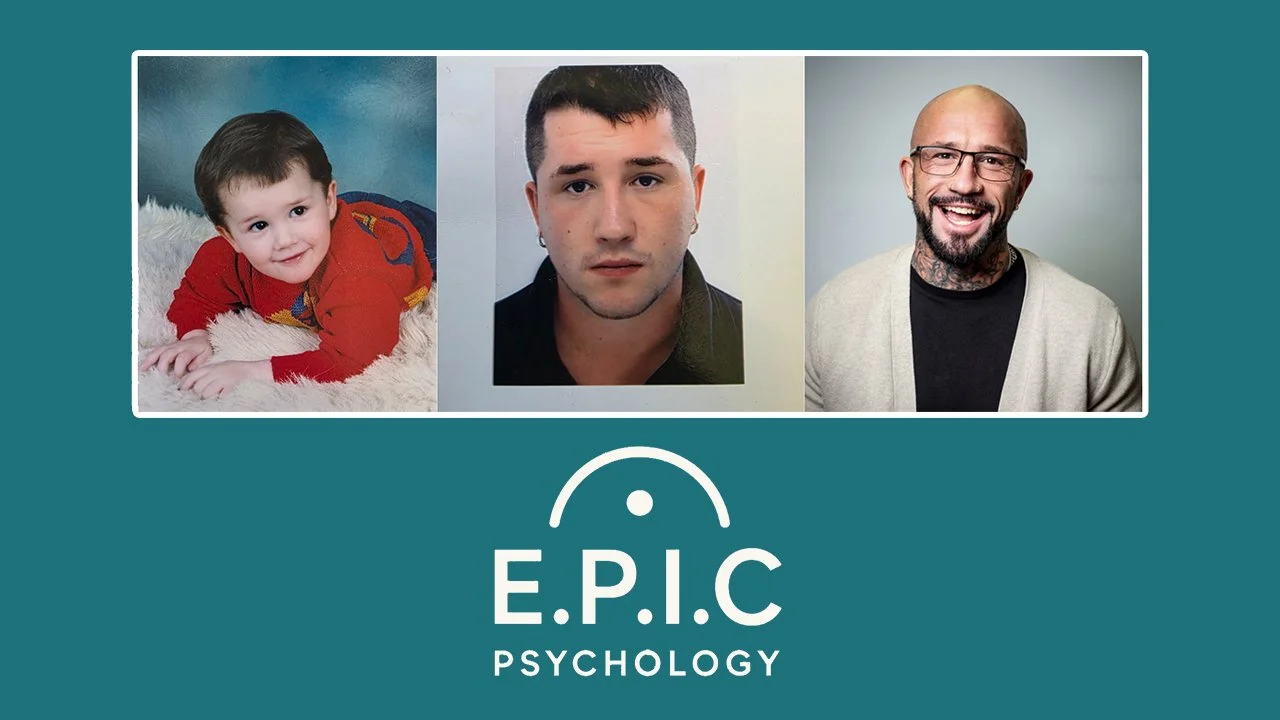
E.P.I.C. Psychology was not built from theory alone. The reason this work matters so much to me is because I know what it means to rebuild yourself from the inside.
My own life forced me to confront how early experience can shape the mind, the nervous system, identity, behaviour, relationships, aggression, fear, shame, and the voice within. I know what it means to live through destructive patterns and then have to understand where they came from. I know what it means to stop pretending the problem is everyone else and start facing the internal system that is creating the same outcomes.
That personal work led me into psychology, forensic psychology, behavioural science, NHS crisis work, academic research, and now into E.P.I.C. Psychology. It is also why the practice is built the way it is. I am not interested in giving people polished advice that sounds good but does not hold up when their life becomes difficult. I am interested in work that changes how a person thinks, responds, interprets, regulates, and identifies themselves.
The work I have done personally and professionally has made one thing clear.
People can change, but change requires more than motivation. It requires honesty, structure, self-confrontation, psychological understanding, repeated practice, and a willingness to stop being ruled by patterns that were built in a different stage of life.
That is the foundation of E.P.I.C. Psychology.
What You Can Expect From Working With Us
The outcome of this work is not that you become perfect or never struggle again. That would be a false promise. The real outcome is that you begin to understand yourself with far more accuracy and respond to life with far more control.
You should expect to develop a clearer understanding of why you think and behave the way you do. You should expect to identify the experiences, beliefs, emotional patterns, and internal narratives that have shaped you. You should expect to build more awareness of your reactions as they are happening, rather than only understanding them afterwards when damage has already been done.
Over time, the aim is to help you become less reactive, less avoidant, less controlled by fear, less dominated by destructive self-talk, and less likely to repeat patterns that are no longer serving you. At the same time, the work is designed to help you build a stronger internal identity, better emotional regulation, clearer decision-making, greater self-respect, and a more disciplined relationship with your own mind.
This is especially important for people who feel they are capable of more but cannot understand why they keep falling back. It is also important for people who are tired of living inside old stories about who they are, what they deserve, and what is possible for their future.
The goal is not to give you dependency on coaching.
The goal is to help you build the internal tools to lead yourself better.
You Are Not Stuck With the Version of You That Was Built by the Past
The past matters because it shaped you, but it does not have to own you.
At some point, every person has to decide whether they are going to keep living through the identity that was built by old experiences, or whether they are going to take responsibility for building something new.
That decision is not always comfortable. It requires you to look honestly at yourself. It requires you to stop defending patterns that are damaging your life. It requires you to stop confusing explanation with excuse. It requires you to stop allowing the voice within to speak to you in ways you would never accept from another person.
But on the other side of that work is a different kind of life.
A life where you understand yourself properly. A life where your mind becomes something you can work with rather than something you are constantly fighting. A life where your internal identity is built around responsibility, direction, self-respect, and conscious choice rather than fear, shame, avoidance, or old pain.
That is what this work is about.
Understanding who you are. Understanding what made you this way. Taking charge of the voice within. Building a new internal identity. Becoming the master of your mind and self, rather than living as a slave to patterns you never consciously chose.
Book a Free Discovery Call
If this resonates with you, the next step is not to read another article and hope something changes.
The next step is to act.
If you are ready to understand yourself properly and start doing the work to change the patterns that keep repeating, book a free discovery call with E.P.I.C. Psychology through our website.
During the call, we will look at where you are now, what you are struggling with, what keeps repeating, and whether individual psychological coaching with E.P.I.C. Psychology is the right fit for you.
If you are tired of being controlled by old patterns, old thoughts, old reactions, and an internal voice that works against you, this is where the work starts.